From Tickets to Outcomes: What Four Practitioners Told Us About the Present and Future of DEX, ITSM, and SRE
About twenty minutes into our webinar on outcome-led service desk, my power went out. I came back online to report that my own digital employee experience had deteriorated considerably. It got a laugh, and it made the point better than any slide could have. The experience is the thing that happens to you. The ticket is just the paperwork that follows.
We brought together guest speaker Christy Punch, Principal Analyst for Digital Workplace and Digital Employee Experience at Forrester, with three people who deliver this at scale every day: Chris Kirkpatrick of Kyndryl, Komal Verma of Capgemini, and Preethi Anantharaman of IBM. Half an hour went by faster than I expected. Here is what stayed with me:
The reactive trap
Christy opened by unpacking how DEX encapsulates the ways technology enables or hinders someone across a workday, which is a much bigger surface than the tools themselves. And that surface is under pressure from three directions at once. Employees are navigating a growing pile of applications that do not talk to each other, which means constant context switching. AI has entered the chat, quite literally, since every platform now ships an agent, and everyone is simultaneously learning to prompt while still using the legacy tools underneath. And return to office has brought people back four or five days a week to workplace technology that quietly aged out while everyone was remote.
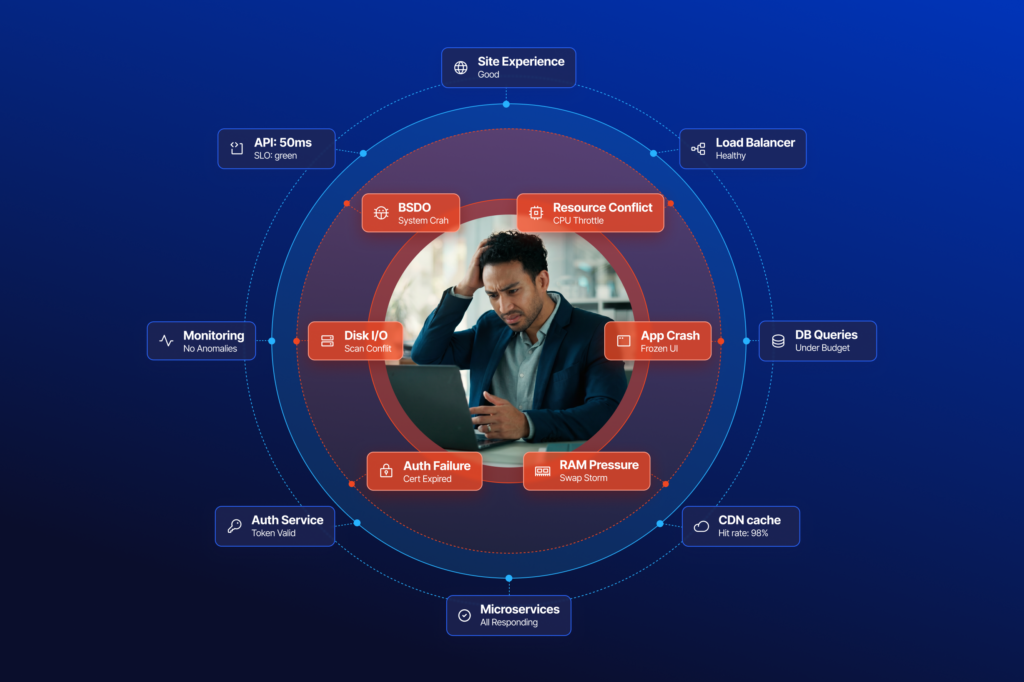
IT is feeling its own version of the squeeze. The business wants ROI on everything; security can’t afford to miss a beat even as the enterprise attack surface grows exponentially, and the stack is a jumble of shared responsibility. Christy called it the pancake effect: layer of legacy, layer of new tooling on top, now a layer of AI on top of that, and somewhere down there is the thing that actually broke. Under those conditions, service teams end up reacting to whatever arrives next, which leaves no room to improve anything.
She had a story about how that goes wrong in practice. She gets tired at work, so she makes a cup of coffee. It helps for a while, then she is tired again, so she makes another. The coffee spend climbs steadily and the tiredness never resolves, because the signal was never the problem. Zoom out and you find the real contributors, none of which are addressed by buying more coffee. In IT terms, ticket volume is the coffee. Reducing it feels like progress right up until you notice the underlying experience has not moved.
What she proposed instead is an end-to-end view of a workflow that matters, using time to shift start productivity as her example. You gather the many signals that suggest friction in that workflow, connect them to experience outcomes that employees would recognize, and then connect those to business outcomes leadership already cares about. That chain is what lets you prove the value of the work.
What outcome-led actually means to people delivering it
I asked each panelist to define it in their own words, and their three answers told a cohesive story.
At IBM, Preethi treats operational metrics as a baseline rather than a scoreboard. Her example was a Windows cumulative update that rolls out and produces login delays on a slice of the fleet. Telemetry sees it immediately. Employees do not. They restart, they wait, they try again, and by the time the first ticket lands, thirty minutes of the morning is gone. The ticket queue is a lagging indicator of something you already knew. IBM is working toward resolving those issues before anyone notices them, which she was candid about being a significant shift that requires real support from internal teams.
From the Kyndryl POV, Chris made two moves. First, he wants to know what the person was trying to accomplish before they opened a ticket. The app is broken, sure, but is it blocking a customer conversation, a project deadline, a report for a stressed-out boss? That context lets you elevate empathy and improve the outcome at the same time. Second, and I thought this was one of the sharpest observations of the session. He pointed out that the phrase “service desk” itself carries connotations that work against an outcome-led mindset. People have consumer-grade expectations now. The vocabulary we use internally shapes what we think we are allowed to build. This ties into a lot of the SRE discussion we’ve been having about ensuring that EUC and the rest of IT are working from the same lexicon.
Komal framed it as moving from tickets resolved to problems eliminated. Response time, resolution time, and average handle time remain useful for operational parameters, and they answer a smaller question than the one the business is asking. From HCL’s perspective, the better question is whether the user got back to work, whether the recurring issue is gone for good, and whether the experience improved. That reframing moves the service desk from a ticket-processing function to a strategic partner. operation with the rest of IT, rather than just being the people EUC tickets get assigned to when the problem’s with the endpoint.
Where AI is earning its keep
Komal sees AI reducing effort across the entire support journey rather than in one place: conversational self-service for users, knowledge surfacing and repetitive task handling for agents, and prediction ahead of incidents. If forced to pick one, she would pick resolution acceleration, getting the right answer to the right person at the right moment. The next wave, in her view, is agents coordinating with other agents to orchestrate outcomes rather than simply answering questions.
Chris offered a maturity model I have been thinking about since: evolve, reinvent, reimagine. Evolving a traditional live-agent desk means agent assist, transcription, knowledge retrieval, ticket summarization, and after-call work, applied across every contact without redesigning the process, which he says adds up to roughly thirty percent savings. Reinventing means a genuine 24/7 digital front door with automated diagnosis, resolution, and orchestration behind it. Reimagining flips the model to prevention and productivity first, which is where self-healing and experience engineering come in, and where he pointed to Christy’s research on running the service desk as a product team.
Preethi gave the most concrete example of all of it. Windows update failures are among the most common tickets IBM sees. Rather than handling each one, her team uses telemetry to ask why the update failed, and a frequent answer turns out to be disk capacity. So, the fix is to silently clean up temp files and the recycle bin, free the space, and let the update complete. The user never notices, and the ticket never exists. Another SRE methodology: focus on reducing toil by solving for the fleet rather than the individual.
So how do we start migrating from tickets to outcomes?
I closed by asking Christy for the single most important first step, and she admitted to cheating with two.
Get your data in order. Garbage in, garbage out applies with force here, because AI correlating bad signal data will confidently produce bad conclusions. She has lost count of the number of teams who cannot categorize their top support issues by employee persona because the data is a mess. Nobody wants to go back and fix that, and predictive support is coming whether you fixed it or not. Think of it as the context graph your service team will run on.
Then, do not boil the ocean. Pick one high-frequency, high-recurrence experience that matters to your organization, work out how to measure it through an experience lens, and find the opportunities to shift left on that one thing. Momentum beats a master plan.
Her closing line is the one I keep repeating: the best service desk interaction is increasingly the one your employees never have to make.
This is the number one question we field as a DEX vendor, and it is really a question about measurement. Moving from SLAs toward XLAs and SLOs, from ticket throughput toward business outcomes, from firefighting toward SRE for EUC, or DEXops if you like.
Thanks to Christy, Chris, Komal, and Preethi for making it worth everyone’s time. And thanks to SysTrack’s engineers for building the script that failed over my network connection from our office wifi to my mobile hotspot and saving this webinar.
Watch the on-demand webinar



Subscribe to Lakeside Updates
Receive product updates, DEX news, and more