
The key questions to ask before you make a decision.
What a difference a few years make in the DEX platform market.
When I went to previous conferences, I would meet with customers and answer questions about what a Digital Employee Experience (DEX) platform does, and why it’s a worthwhile investment.
But when I go to conferences this year, it’s clear that most people already know what DEX can do for their enterprise. Now, they’re on a mission: find the right DEX tool for their organization. And that means they need to start asking different questions.
Why DEX Moved Quickly to the Right Side of the Maturity Curve
DEX has moved from a “nice to have” add-on to a “must have” investment. In fact, in a Lenovo survey, nearly half of IT leaders said the employee experience is “their top priority for the year ahead.”
There are two key reasons for the rapid adoption of DEX:
- Thought leadership from market research companies including Gartner, which has been advocating for employee-centric IT delivery for years through whitepapers, presentations, and other channels.
- AI-driven advances in DEX tools, which have accelerated vendors’ ability to drive rapid value and validate customer investments.
How to Choose a DEX Platform Today
In a mature market, you have access to more information, so instead of asking if the DEX platform works, you’re learning how well it performs. That means more in-depth questions and thinking further ahead.
As someone who talks about DEX every day, here’s my advice — including how to frame the decision, how to think about what it actually costs you, and how AI changes the expectations.
Get the DEX Tool Buying Guide
Renewal coming up? Learn the key questions to ask your vendor.
1. Start With Your Goals, Not Your Solution or Budget
Your first priority should be identifying the problems that you want to solve within your organization. When you focus your attention on the problem, the market category and solution should be irrelevant. If DEX tools are right for you, they should stand out not because of buzzwords, but because they actually address your need for a reliable digital experience.
Unfortunately, many enterprises start by identifying the solution and establishing their budget before even knowing what they want to accomplish. We’ve seen this same pattern with AI — a trend I wrote about in my last article on delivering ROI on AI initiatives.
2. Go Beyond User Experience and Sentiment and Leverage Site Reliability Engineering Principles
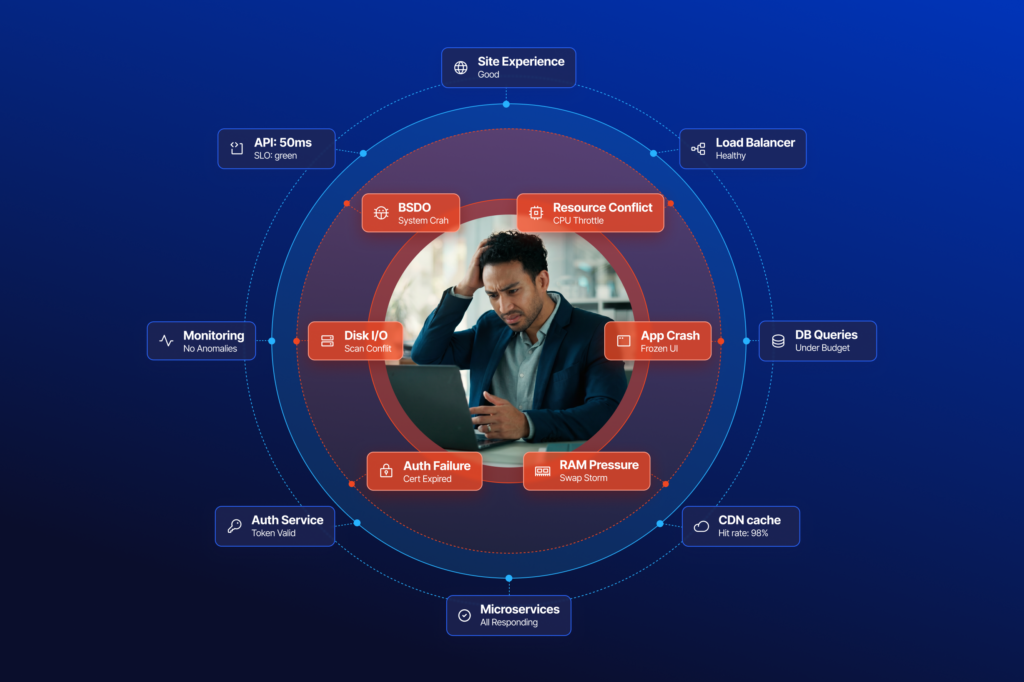
When you talk about the digital employee experience, many people skip over a key question: Does the employees’ technology actually work?
As IBM explains, Site Reliability Engineering (SRE) teams “bridge the gap between how software developers want programs to function and how they function in real-world situations.” If IT says the network is up but your sales team can’t send or receive emails, it doesn’t really matter what the dashboard says; there’s a real-world problem that needs to be fixed.
SRE puts the focus on reliability and ensuring tools can be available for employees whenever and wherever they need them. As Gartner explained in their “Employee Technology Through 2030” presentation, “SRE enables employee-centric reliability.” If you’re spending money on DEX without also emphasizing SRE, you’re likely wasting a good chunk of your DEX budget.
3. Consider the Hidden Costs Within DEX
While the number of help desk tickets matters, the real tax is inside the Mean Time to Repair (MTTR) score, which measures how long it takes to resolve an issue.
I’ve seen firsthand that 60%- 70% of the resolution time for IT tickets is spent on interrogation — including identifying users, verifying permissions, and gathering incident details. It’s a process filled with re-diagnosis and ticket bouncing, as engineers repeat diagnostic steps rather than build on previous findings. Here’s what happens — and why the cost of a help desk ticket quickly jumps to $50 or more:
- A user can’t print a sales proposal. They try to fix the problem themselves but can’t, so they submit a ticket.
- An L1 support engineer asks the user questions about their system status, software updates, and other contributing factors, but is unable to find the root cause and escalates to an L2.
- Due to a lack of trust, the L2 engineer spends 20 minutes verifying all the information gathered by the L1 engineer — but still can’t solve the issue, so they escalate it to L3.
- The L3 spends another 15 minutes personally verifying everything that the L1 and L2 already confirmed before they even touch the production systems.
You’ve now paid for 30 minutes of labor for essentially zero forward progress. This “verification tax” effectively doubles the diagnostic cost of every escalated ticket. If your goal is to reduce time-to-resolution and costs, you need to understand how DEX platforms use telemetry and other tools to eliminate the trust tax.
4. Choose a Solution That Meets You Where You Are and Scales with You
A DEX platform should be aligned with your organization’s digital maturity level. Yet too often, I see companies interested in DEX platforms built for a maturity level they haven’t reached yet.
For example, according to the Gartner presentation “Lead With Impact: North Star DEX Leaders,” 0% of companies have reached the highest level of “Digital Workplace Maturity” — yet 51% of CIOs expect to be here.
These types of ambition gaps can lead to overconfidence and push you into the wrong solution. For achievable results, pay attention to how well DEX solutions align with your maturity level.
5. Ask How AI Maps the Data (and Validate DEX Platform Vendor Claims)
With AI, the DEX market has evolved from focusing on telemetry and automation to providing deeper insights — but often with less transparency, especially around agents and automations. Some organizations accept that trade-off for AI’s ability to analyze data at scale, but be careful about how much control you’re giving up.
Specifically, understand how much visibility you’ll have into both manual and autonomous actions. When the AI flags a root cause, can it show the actual telemetry it used to reach that conclusion — or does it just offer a confidence score? Ask specific questions about how it works, and make sure any claims can be validated.
6. Look Forward to “Headless” AI Systems
As AI becomes embedded in enterprise workflows, the value of a platform will extend far beyond the interface employees interact with. The real opportunity lies in creating “headless” systems that expose the right data, context, and actions — regardless of the interface. Headless systems help unlock autonomous capabilities, so AI can identify issues, orchestrate workflows, or trigger remediation without requiring constant human input.
This shift requires thinking beyond dashboards and user experiences to the underlying architecture and value. Is the platform built to make its data and capabilities accessible? Can it support autonomous action without sacrificing transparency or governance? Can AI interact with enterprise systems in a consistent, explainable way across every application?
A year ago, the DEX conversation was about proving its worth. Today, in a mature DEX platform market, the goal is buying the right fit — one that matches your maturity level, addresses the real costs of resolving IT issues, and is transparent about what its AI is actually doing.



Subscribe to Lakeside Updates
Receive product updates, DEX news, and more