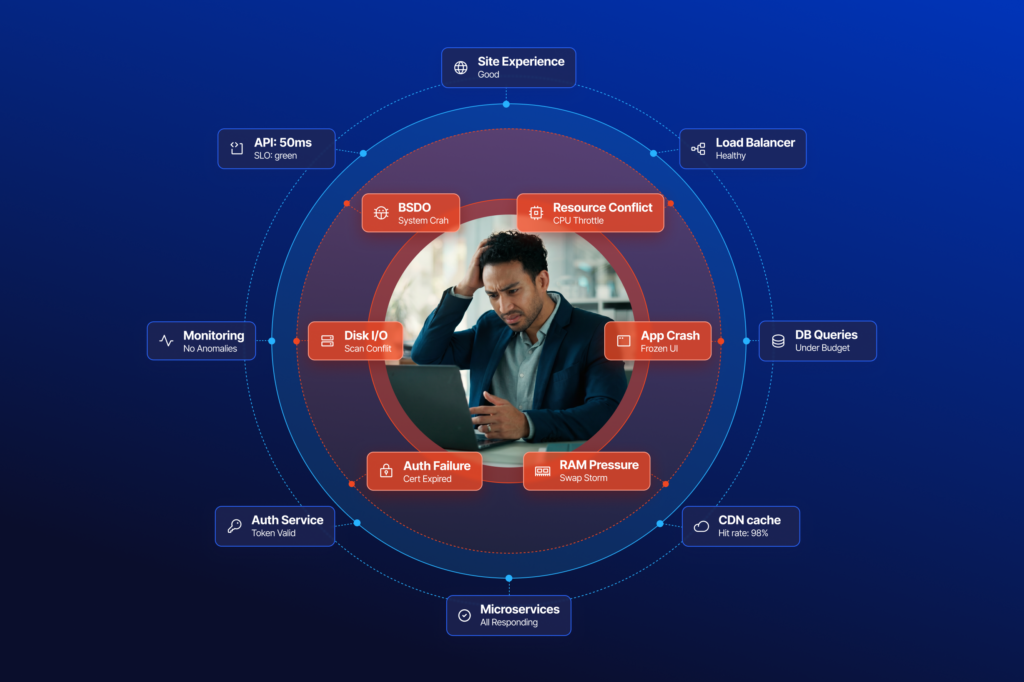

While DEX traditionally lived in the realm of End-User Computing (EUC) and IT support—focused on device health, software deployment, and helpdesk tickets—the increasing complexity of the modern workplace is forcing a shift. As companies rely more on distributed systems, cloud applications, and hybrid work models, the methods used to ensure employee productivity have had to evolve.
Here is a breakdown of why this convergence is happening and how site reliability engineering (SRE) principles are reshaping DEX roles.
Why DEX is Adopting SRE Principles
The core reason for this shift is scale and complexity. When employees rely on a web of SaaS applications, identity providers, VPNs, and local hardware, a failure in any one link degrades the employee experience. Traditional IT support reacts to these failures; SRE aims to prevent them.
- From Reactive to Proactive: SRE applies software engineering mindsets to operational problems. Instead of waiting for a user to submit a ticket when an application crashes, an SRE approach uses automation and telemetry to detect and resolve the issue before the user is even aware of it.
- Treating Infrastructure as Code: Modern DEX roles increasingly involve managing configurations, policies, and deployments programmatically. Experience managing infrastructure as code (using tools like Terraform) is becoming highly valuable for ensuring consistent and reliable end-user environments.
- Focus on Telemetry and Observability: Just as SREs rely heavily on monitoring server health and application performance, DEX professionals are adopting advanced observability tools. This allows them to track the entire chain of employee experience—from device performance to network latency to SaaS availability.
Key SRE Concepts Entering the DEX Career Path
If you are looking at modern DEX job postings, you will likely see these SRE concepts featured prominently:
| SRE Concept | Traditional DEX Focus | Modern DEX Focus |
| SLAs vs. SLOs | Did the endpoint meet the agreed-upon SLA/XLA? | Is the system actually performing at a level that keeps employees ideally productive in the context of their business function (SLO)? |
| Error Budgets | Any downtime is a failure that must be fixed immediately. | We accept a small, defined amount of instability to allow for rapid innovation, security, and updates. |
| Toil Reduction | Manually resetting passwords, provisioning devices, and fixing recurring issues. | Automating repetitive tasks so engineers can focus on building better systems and tools. |
| Blameless Postmortems | Who caused the outage and how do we punish them? | What systemic failure allowed the outage to happen, and how do we engineer the system to prevent it in the future? |
Don’t take my word for it. Do a search for “DEX Engineer” job postings and you’ll find them now asking for experience with scripting languages (like Python or Go), configuration management, and a deep understanding of networking protocols—skills that look very similar to an SRE resume.
The bottom line is that as the employee experience becomes entirely reliant on complex digital infrastructure, companies need people who can engineer reliability holistically into that infrastructure in cooperation with the rest of IT, rather than just being the people EUC tickets get assigned to when the problem’s with the endpoint.
Learn More About SRE for EUC
Why Endpoint Reliability is the “Last Mile” of Site Resilience



Subscribe to Lakeside Updates
Receive product updates, DEX news, and more